Biotechnology Center Of Ho Chi Minh City


Potential applications of genome editing for flower color improvement in ornamental plants
Flower color is a key trait that determines the aesthetic value, cultivar distinctness, and commercial appeal of ornamental plants. Consequently, developing cultivars with novel and distinctive flower colors is a central objective for horticultural breeders. Conventional sexual hybridization has long been used and continues to generate a wide range of color variation; however, this process is typically time-consuming and may simultaneously alter other, undesirable agronomic traits. Genome editing, particularly the CRISPR/Cas9 system, now offers a more targeted approach by introducing modifications in genes involved in pigment formation, regulation, or accumulation, enabling the development of desired color phenotypes and potentially novel color combinations (Giovannini et al., 2021; Mekapogu et al., 2023).
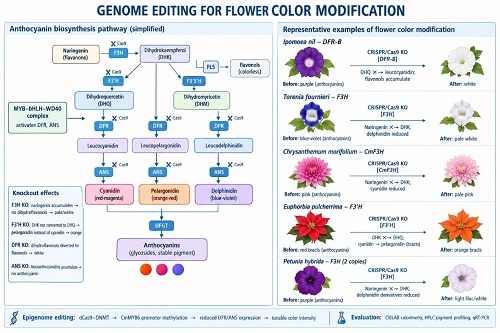
Biologically, flower color results from the interplay of multiple factors, including pigment type and content, vacuolar pH, co-pigmentation, metal ions, and the cellular characteristics of the petal. Anthocyanins are a major class of pigments responsible for red, pink, and purple hues and contribute to blue coloration; structural genes such as DFR (dihydroflavonol 4-reductase), F3H (flavanone 3-hydroxylase), and ANS (anthocyanidin synthase) participate directly in this biosynthetic pathway. In principle, therefore, inactivating an essential gene can reduce or abolish anthocyanin production, whereas modifying other genes can alter pigment composition and color intensity. Nevertheless, flower color in planta is rarely determined by a single gene; selecting editing targets should be guided by an understanding of the biochemical pathway and each species' genetic background (Mekapogu et al., 2023).
Experimental studies have demonstrated the feasibility of this approach in several ornamental species. In Japanese morning glory (Ipomoea nil), CRISPR/Cas9-mediated editing of the DFR-B gene altered pigmentation and produced white-flowered phenotypes from a purple-flowered background, showing that flower color can be directly modified by editing endogenous genes (Watanabe et al., 2017). In Torenia fournieri, Nishihara et al. (2018) edited F3H and obtained lines with pale, near-white flowers, with 20 of 24 regenerated lines exhibiting altered flower color. This result provides important evidence that readily recognizable phenotypes can be generated, although this rate reflects a specific experimental system and does not represent an efficiency applicable to all species or cultivars.
In chrysanthemum (Chrysanthemum morifolium), editing the CmF3H gene has generated lines with reduced anthocyanin content, illustrating the potential to lighten flower color by targeting the pigment pathway (Kishi-Kaboshi et al., 2017). In poinsettia (Euphorbia pulcherrima), Nitarska et al. (2021) targeted the F3′H gene and observed a shift in flavonoid composition toward orange bract coloration. This is a notable example of the potential to extend color editing to other pigments and color-bearing organs; however, poinsettia bracts are the conspicuous colored structures but are not petals in the botanical sense. Overall, the current evidence is most convincing for generating white flowers, reducing color intensity, or shifting hue, rather than creating an entirely new color.
A further prospect is moving from single-gene knockout to more refined modulation. In species with homologous gene copies, simultaneous editing of multiple copies may be required to avoid functional compensation; a study in petunia (Petunia hybrida) showed that simultaneously targeting two duplicated F3H genes can produce a more pronounced change in flower color (Yu et al., 2021). In addition to DNA sequence editing, researchers are investigating targeted epigenome editing to regulate gene expression. Li et al. (2025) reported using dCas9 fused to a DNA methyltransferase to target the CmMYB6 promoter in chrysanthemum, altering its methylation status, gene expression, and flower color intensity. This approach holds promise for more flexible, tunable modulation, but it should be distinguished from DNA sequence editing because dCas9 does not directly cleave DNA at the target site.
Despite these clear prospects, several barriers remain before the technology can be widely applied in commercial breeding. Many ornamental species have polyploid, highly heterozygous genomes or multiple gene copies, which complicates the generation of the desired genotypes. Transformation and plant regeneration efficiencies also depend strongly on species, cultivar, and explant type; additionally, researchers must assess chimerism, off-target modifications, foreign DNA, and color stability across multiple flowering cycles and rounds of propagation. Furthermore, flower color should be evaluated using objective methods, such as CIELAB colorimetry and pigment analysis, rather than by visual observation alone (Mekapogu et al., 2023). Notably, eliminating anthocyanins is generally easier than creating a novel blue color, because blue coloration also depends on anthocyanin type, vacuolar pH, co-pigmentation, and other chemical factors.
In Vietnam, priority may be given to high-value species with relatively well-established tissue culture systems, such as chrysanthemum, petunia, or torenia, to standardize the workflow from target gene selection and CRISPR/Cas9 design to plant regeneration, mutation confirmation, and quantification of color and pigments. Only after a stable phenotype has been demonstrated in one genetic background should research be extended to species with more complex genomes. In conclusion, genome editing is a promising tool to complement conventional breeding, enabling targeted modification of flower color and accelerating gene function analysis. However, it should be regarded as a developing technology: success in initial experimental lines does not imply stable commercial cultivars or entirely new color spectra, and developing an ornamental cultivar with stable flower color requires evaluation over multiple generations and under diverse growing conditions.
REFERENCES
Giovannini, A., Laura, M., Nesi, B., Savona, M., & Cardi, T. (2021). Genes and genome editing tools for breeding desirable phenotypes in ornamentals. Plant Cell Reports, 40, 461–478. https://doi.org/10.1007/s00299-020-02632-x
Kishi-Kaboshi M., Aida R., Sasaki K., (2017) Generation of Gene-Edited Chrysanthemum morifolium Using Multicopy Transgenes as Targets and Markers. Plant and Cell Physiology, 58 (2) 216–226, https://doi.org/10.1093/pcp/pcw222
Li, X., Bu, F., Zhang, M., Li, Z., Zhang, Y., Chen, H., Xue, W., Guo, R., Qi, J., Kim, C., Kawabata, S., Wang, Y., Zhang, Q., Li, Y., & Zhang, Y. (2025). Enhancing nature’s palette through the epigenetic breeding of flower color in chrysanthemum. New Phytologist, 245(5), 2117–2132. https://doi.org/10.1111/nph.20347
Mekapogu, M., Song, H.-Y., Lim, S.-H., & Jung, J.-A. (2023). Genetic engineering and genome editing advances to enhance floral attributes in ornamental plants: An update. Plants, 12(23), Article 3983. https://doi.org/10.3390/plants12233983
Nishihara, M., Higuchi, A., Watanabe, A., & Tasaki, K. (2018). Application of the CRISPR/Cas9 system for modification of flower color in Torenia fournieri. BMC Plant Biology, 18, Article 331. https://doi.org/10.1186/s12870-018-1539-3
Nitarska, D., Boehm, R., Debener, T., Lucaciu, R. C., & Halbwirth, H. (2021). First genome edited poinsettias: targeted mutagenesis of flavonoid 3'-hydroxylase using CRISPR/Cas9 results in a colour shift. Plant Cell Tissue Organ Cult.147(1):49-60. doi: 10.1007/s11240-021-02103-5.
Watanabe, K., Kobayashi, A., Endo, M., Sage-Ono, K., Toki, S., & Ono, M. (2017). CRISPR/Cas9-mediated mutagenesis of the dihydroflavonol-4-reductase-B (DFR-B) locus in the Japanese morning glory Ipomoea (Pharbitis) nil. Scientific Reports, 7, Article 10028. https://doi.org/10.1038/s41598-017-10715-1
Yu, J., Tu, L., Subburaj, S., Bae, S., & Lee, G. J. (2021). Simultaneous targeting of duplicated genes in Petunia protoplasts for flower color modification via CRISPR-Cas9 ribonucleoproteins. Plant Cell Rep. 40(6):1037-1045. https://doi.org/10.1007/s00299-020-02593-1.
Biologically, flower color results from the interplay of multiple factors, including pigment type and content, vacuolar pH, co-pigmentation, metal ions, and the cellular characteristics of the petal. Anthocyanins are a major class of pigments responsible for red, pink, and purple hues and contribute to blue coloration; structural genes such as DFR (dihydroflavonol 4-reductase), F3H (flavanone 3-hydroxylase), and ANS (anthocyanidin synthase) participate directly in this biosynthetic pathway. In principle, therefore, inactivating an essential gene can reduce or abolish anthocyanin production, whereas modifying other genes can alter pigment composition and color intensity. Nevertheless, flower color in planta is rarely determined by a single gene; selecting editing targets should be guided by an understanding of the biochemical pathway and each species' genetic background (Mekapogu et al., 2023).
Experimental studies have demonstrated the feasibility of this approach in several ornamental species. In Japanese morning glory (Ipomoea nil), CRISPR/Cas9-mediated editing of the DFR-B gene altered pigmentation and produced white-flowered phenotypes from a purple-flowered background, showing that flower color can be directly modified by editing endogenous genes (Watanabe et al., 2017). In Torenia fournieri, Nishihara et al. (2018) edited F3H and obtained lines with pale, near-white flowers, with 20 of 24 regenerated lines exhibiting altered flower color. This result provides important evidence that readily recognizable phenotypes can be generated, although this rate reflects a specific experimental system and does not represent an efficiency applicable to all species or cultivars.
In chrysanthemum (Chrysanthemum morifolium), editing the CmF3H gene has generated lines with reduced anthocyanin content, illustrating the potential to lighten flower color by targeting the pigment pathway (Kishi-Kaboshi et al., 2017). In poinsettia (Euphorbia pulcherrima), Nitarska et al. (2021) targeted the F3′H gene and observed a shift in flavonoid composition toward orange bract coloration. This is a notable example of the potential to extend color editing to other pigments and color-bearing organs; however, poinsettia bracts are the conspicuous colored structures but are not petals in the botanical sense. Overall, the current evidence is most convincing for generating white flowers, reducing color intensity, or shifting hue, rather than creating an entirely new color.
A further prospect is moving from single-gene knockout to more refined modulation. In species with homologous gene copies, simultaneous editing of multiple copies may be required to avoid functional compensation; a study in petunia (Petunia hybrida) showed that simultaneously targeting two duplicated F3H genes can produce a more pronounced change in flower color (Yu et al., 2021). In addition to DNA sequence editing, researchers are investigating targeted epigenome editing to regulate gene expression. Li et al. (2025) reported using dCas9 fused to a DNA methyltransferase to target the CmMYB6 promoter in chrysanthemum, altering its methylation status, gene expression, and flower color intensity. This approach holds promise for more flexible, tunable modulation, but it should be distinguished from DNA sequence editing because dCas9 does not directly cleave DNA at the target site.
Despite these clear prospects, several barriers remain before the technology can be widely applied in commercial breeding. Many ornamental species have polyploid, highly heterozygous genomes or multiple gene copies, which complicates the generation of the desired genotypes. Transformation and plant regeneration efficiencies also depend strongly on species, cultivar, and explant type; additionally, researchers must assess chimerism, off-target modifications, foreign DNA, and color stability across multiple flowering cycles and rounds of propagation. Furthermore, flower color should be evaluated using objective methods, such as CIELAB colorimetry and pigment analysis, rather than by visual observation alone (Mekapogu et al., 2023). Notably, eliminating anthocyanins is generally easier than creating a novel blue color, because blue coloration also depends on anthocyanin type, vacuolar pH, co-pigmentation, and other chemical factors.
In Vietnam, priority may be given to high-value species with relatively well-established tissue culture systems, such as chrysanthemum, petunia, or torenia, to standardize the workflow from target gene selection and CRISPR/Cas9 design to plant regeneration, mutation confirmation, and quantification of color and pigments. Only after a stable phenotype has been demonstrated in one genetic background should research be extended to species with more complex genomes. In conclusion, genome editing is a promising tool to complement conventional breeding, enabling targeted modification of flower color and accelerating gene function analysis. However, it should be regarded as a developing technology: success in initial experimental lines does not imply stable commercial cultivars or entirely new color spectra, and developing an ornamental cultivar with stable flower color requires evaluation over multiple generations and under diverse growing conditions.
REFERENCES
Giovannini, A., Laura, M., Nesi, B., Savona, M., & Cardi, T. (2021). Genes and genome editing tools for breeding desirable phenotypes in ornamentals. Plant Cell Reports, 40, 461–478. https://doi.org/10.1007/s00299-020-02632-x
Kishi-Kaboshi M., Aida R., Sasaki K., (2017) Generation of Gene-Edited Chrysanthemum morifolium Using Multicopy Transgenes as Targets and Markers. Plant and Cell Physiology, 58 (2) 216–226, https://doi.org/10.1093/pcp/pcw222
Li, X., Bu, F., Zhang, M., Li, Z., Zhang, Y., Chen, H., Xue, W., Guo, R., Qi, J., Kim, C., Kawabata, S., Wang, Y., Zhang, Q., Li, Y., & Zhang, Y. (2025). Enhancing nature’s palette through the epigenetic breeding of flower color in chrysanthemum. New Phytologist, 245(5), 2117–2132. https://doi.org/10.1111/nph.20347
Mekapogu, M., Song, H.-Y., Lim, S.-H., & Jung, J.-A. (2023). Genetic engineering and genome editing advances to enhance floral attributes in ornamental plants: An update. Plants, 12(23), Article 3983. https://doi.org/10.3390/plants12233983
Nishihara, M., Higuchi, A., Watanabe, A., & Tasaki, K. (2018). Application of the CRISPR/Cas9 system for modification of flower color in Torenia fournieri. BMC Plant Biology, 18, Article 331. https://doi.org/10.1186/s12870-018-1539-3
Nitarska, D., Boehm, R., Debener, T., Lucaciu, R. C., & Halbwirth, H. (2021). First genome edited poinsettias: targeted mutagenesis of flavonoid 3'-hydroxylase using CRISPR/Cas9 results in a colour shift. Plant Cell Tissue Organ Cult.147(1):49-60. doi: 10.1007/s11240-021-02103-5.
Watanabe, K., Kobayashi, A., Endo, M., Sage-Ono, K., Toki, S., & Ono, M. (2017). CRISPR/Cas9-mediated mutagenesis of the dihydroflavonol-4-reductase-B (DFR-B) locus in the Japanese morning glory Ipomoea (Pharbitis) nil. Scientific Reports, 7, Article 10028. https://doi.org/10.1038/s41598-017-10715-1
Yu, J., Tu, L., Subburaj, S., Bae, S., & Lee, G. J. (2021). Simultaneous targeting of duplicated genes in Petunia protoplasts for flower color modification via CRISPR-Cas9 ribonucleoproteins. Plant Cell Rep. 40(6):1037-1045. https://doi.org/10.1007/s00299-020-02593-1.
Author: Huynh Huu Duc
Older articles
Events
-
 The 13th Asian Congress on Biotechnology (ACB 2017)...
- 26/01/2017 04:49:00 AM
-
 Welcome to the 19th A-IMBN Annual Conference 2016
- 21/04/2016 01:29:00 PM
-
 Groundbreaking Ceremony for Components of the HCMBiotech...
- 06/11/2015 10:51:00 AM
-
 Artificial Cell Demonstrates Dynamic Gene Regulation...
- 06/11/2015 10:23:00 AM
-
 Low-Cost Sophisticated Device Diagnoses HIV (10-12-2014)
- 06/11/2015 10:20:00 AM
Visitors


Photos activities


Weblinks


