Biotechnology Center Of Ho Chi Minh City


From Soil to Coffee Fruit: Exploring the Microbial World for Future Coffee Quality Control

Vietnamese Robusta coffee (Coffea canephora) and its coffee-growing landscape. Source: AI-generated image.
A new study by researchers from the Biotechnology Center of Ho Chi Minh City and international collaborators has revealed distinct patterns in the rhizosphere and fruit microbiomes of Coffea canephora grown under conventional, transitional, and organic farming practices. The findings provide new insights into how agricultural management may shape microbial communities associated with coffee plants.Coffee production is an important agricultural sector in Vietnam, particularly for Coffea canephora (Robusta coffee). As the industry increasingly moves toward sustainable and environmentally friendly production, understanding the biological processes underlying soil and plant health has become increasingly important. Among these processes, microorganisms play essential roles in nutrient cycling, organic matter decomposition, plant–microbe interactions, and potentially coffee quality.
Researchers from the Biotechnology Center of Ho Chi Minh City, in collaboration with scientists from RIKEN, the University of Tsukuba, and Tottori University, investigated bacterial communities associated with the rhizosphere and coffee fruits from farms representing three management systems: conventional, transitional organic, and organic farming. The microbial communities were characterized using 16S rRNA gene sequencing, followed by bioinformatic analyses to compare their composition and diversity across the different farming systems.
The results showed that farming practices were associated with differences in the composition of rhizosphere bacterial communities. The conventional farm showed a higher relative abundance of bacterial groups associated with processes such as nitrification and environmental stress adaptation, whereas the organic farm contained higher proportions of some microorganisms involved in the decomposition of complex organic compounds.
Interestingly, the microbial community of the transitional organic farm showed relatively smaller differences from the conventional farm, while more pronounced changes were observed between the transitional and organic systems. These findings suggest that changes in the soil microbiome may occur progressively during the transition toward organic management and may reflect longer-term changes in agricultural practices and soil conditions.
Another important aspect of the study was the comparison between rhizosphere and fruit-associated microbiomes. Approximately 30% of the bacterial taxa detected were shared between the rhizosphere and coffee fruits. Several shared microorganisms, including Lactobacillus plantarum, Leuconostoc mesenteroides, Kozakia baliensis, and other acetic acid bacteria, are microorganisms known to be associated with coffee fermentation.
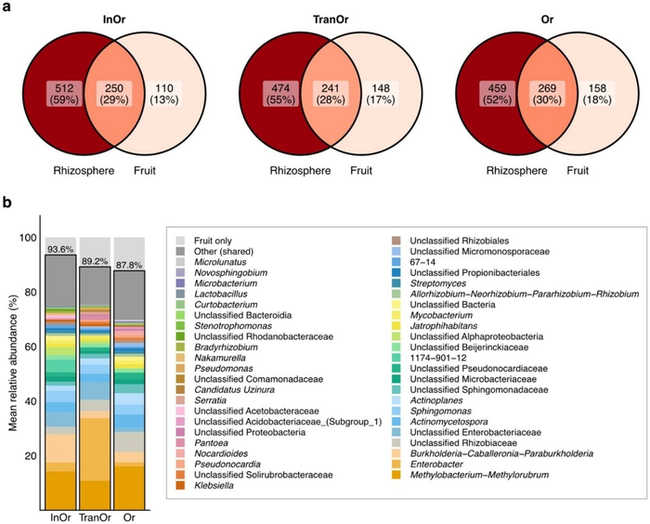
Bacterial communities shared between coffee roots and fruits under different farming practices. (a) The diagrams show the number of bacterial groups found in the rhizosphere (soil around the roots) and coffee fruits, including those shared by both. (b) The chart shows the main bacterial groups found in coffee fruits and the proportion also found in the rhizosphere. Results are based on three samples from each farm. Source: Le et al. (2026), Frontiers in Microbiology.
Although the shared taxa represented only about 30% of the detected bacterial taxa, they accounted for more than 85% of the total bacterial abundance on coffee fruits. This finding suggests a potentially important connection between microbial communities in the rhizosphere and those associated with coffee fruits. However, further studies involving a larger number of farms and experimental approaches will be needed to determine the mechanisms underlying this relationship.
The study highlights the potential of microbiome analysis as a biological approach for understanding and monitoring changes in coffee agroecosystems. In addition to conventional measurements of soil chemical properties and crop productivity, microbial community profiling may provide complementary information about soil health, nutrient cycling, and the biological effects of different farming practices.
The findings also provide a basis for future research linking the soil–rhizosphere–fruit microbiome with coffee metabolites, fermentation processes, and cup quality. Integrating microbiome data with metabolomics and environmental information could help clarify how farming practices influence coffee quality from production in the field to post-harvest processing.
This work contributes to the broader research activities of the Biotechnology Center of Ho Chi Minh City and its international partners toward understanding the complex biological systems underlying Vietnamese coffee production. Future studies involving multiple farms across different coffee-growing regions will be important to validate these findings and to develop a more comprehensive understanding of the Vietnamese coffee microbiome.
The study, entitled “Rhizosphere and fruit microbiome variation across Coffea canephora farms representing conventional, transitional, and organic management,” has been published in Frontiers in Microbiology.
Read the full article:
https://www.frontiersin.org/journals/microbiology/articles/10.3389/fmicb.2026.1899736/full
Author: Le Thi Mai Cham
Newer articles
Older articles
Events
-
 The 13th Asian Congress on Biotechnology (ACB 2017)...
- 26/01/2017 04:49:00 AM
-
 Welcome to the 19th A-IMBN Annual Conference 2016
- 21/04/2016 01:29:00 PM
-
 Groundbreaking Ceremony for Components of the HCMBiotech...
- 06/11/2015 10:51:00 AM
-
 Artificial Cell Demonstrates Dynamic Gene Regulation...
- 06/11/2015 10:23:00 AM
-
 Low-Cost Sophisticated Device Diagnoses HIV (10-12-2014)
- 06/11/2015 10:20:00 AM
Visitors


Photos activities


Weblinks


